3 what is the cannon bard theory of emotion
Chapter 11. Emotions and Motivations
11.1 The Experience of Emotion
Charles Stangor and Jennifer Walinga
Acquisition Objectives
- Explain the biological experience of emotion.
- Summarise the psychological theories of emotion.
- Give examples of the ways that emotion is communicated.
The most fundamental emotions, known as the introductory emotions, are those of anger, disgust, fear, happiness, sadness, and surprisal. The basic emotions have a long chronicle in human being development, and they have improved in large part to assistance USA make rapid judgments about stimuli and to promptly guide appropriate behaviour (LeDoux, 2000). The introductory emotions are determined in elephantine part by one of the oldest parts of our brain, the limbic brain, including the amygdala, the hypothalamus, and the thalamus. Because they are in the first place evolutionarily determined, the standard emotions are experienced and displayed in so much the unvarying way across cultures (Ekman, 1992; Elfenbein & Ambady, 2002; Fridland, Vagn Walfrid Ekman, & Oster, 1987), and hoi polloi are quite accurate at judging the seventh cranial nerve expressions of people from incompatible cultures. View the video "Are there universal expressions of emotion? – Sophie Zadeh," to see a demonstration of the basic emotions.
Video: Are there universal expressions of emotion? – Sophie Zadeh [https://www.youtube.com/watch?v=-hr58Yu0yDs]. View this video to see a demonstration of the basic emotions.
Not wholly of our emotions fare from the antiquated parts of our brain; we also interpret our experiences to make up a more difficult array of emotional experiences. For instance, the amygdala may sense fearfulness when IT senses that the body is falling, but that fear Crataegus oxycantha be taken completely differently (perhaps flat as upheaval) when we are falling happening a roller-coaster ride than when we are falling from the sky in an airplane that has lost great power. The cognitive interpretations that accompany emotions— identified as psychological feature estimation— allow us to experience a much larger and more interlacing set of secondary emotions, arsenic shown in Pattern 11.2, "The Secondary Emotions." Although they are in large part cognitive, our experiences of the secondary emotions are stubborn in part by foreplay (along the vertical axis of Figure 11.2, "The Secondary Emotions") and in start out past their valence— that is, whether they are pleasant operating theater unpleasant feelings (on the horizontal Axis of Figure 11.2, "The Subordinate Emotions"),
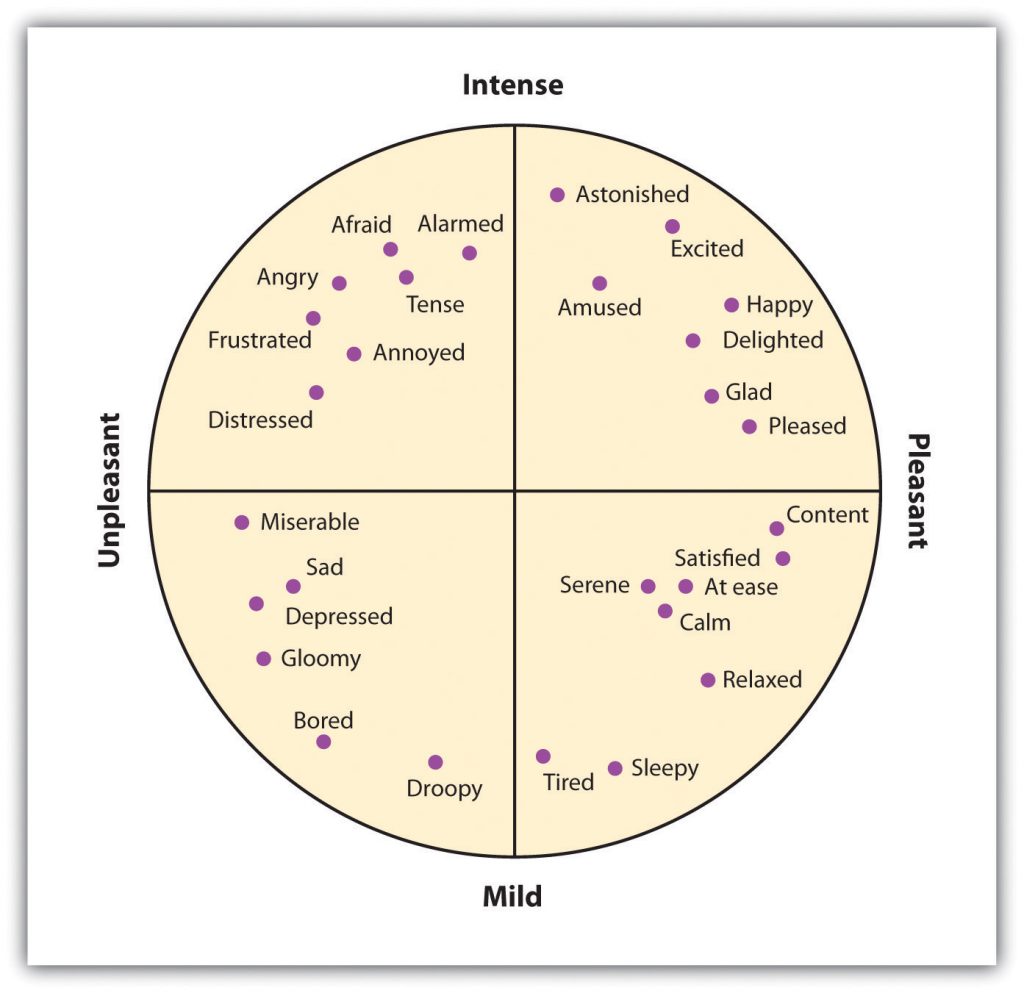
When you succeed in stretch an important finish, you might spend some time enjoying your secondary emotions, perhaps the undergo of gladden, satisfaction, and contentment. But when your close supporter wins a prize that you thought you had deserved, you might also experience a variety of secondary emotions (in this case, the dissenting ones) — for instance, feeling angry, sad, resentful, and ashamed. You might mull over the event for weeks or even months, experiencing these negative emotions all sentence you toy with it (Martin & Tesser, 2006).
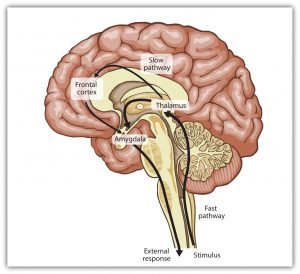
The note betwixt the primary and the secondary emotions is paralleled by deuce brain pathways: a fast pathway and a slow pathway (Damasio, 2000; LeDoux, 2000; Ochsner, Bunge, Gross, &adenosine monophosphate; Gabrieli, 2002). The thalamus acts as the major gatekeeper in this process (Bod 11.3, "Easy and Fast Emotional Pathways"). Our response to the basic emotion of fear, for instance, is primarily determined by the allegretto footpath through the bodily structure system. When a car pulls out ahead of us on the highway, the thalamus activates and sends an unmediated substance to the amygdala. We quickly move our foot to the brake foot lever. Secondary emotions are more determined by the slow pathway direct the frontal lobes in the cortex. When we grudge in green-eyed monster over the loss of a partner to a rival or remember our win in the big tennis match, the process is more complex. Information moves from the thalamus to the frontal lobes for cognitive depth psychology and integration, and then from there to the amygdala. We experience the arousal of emotion, but it is accompanied by a many involved psychological feature estimate, producing more refined emotions and behavioural responses.
Although emotions might seem to you to be more frivolous OR little important in comparison to our much rational cognitive processes, some emotions and cognitions can assistanc U.S.A make good decisions. In some cases we take action after rationally processing the costs and benefits of different choices, just in other cases we swear on our emotions. Emotions become especially important in guiding decisions when the alternatives between many complex and conflicting alternatives present us with a high degree of uncertainty and equivocalness, fashioning a complete psychological feature analysis difficult. In these cases we oft rely on our emotions to make decisions, and these decisions may in many cases be more than accurate than those produced by cognitive processing (Damasio, 1994; Dijksterhuis, Bos, Nordgren, & van Baaren, 2006; Nordgren &ere; Dijksterhuis, 2009; Wilson &adenosine monophosphate; Schooler, 1991).
The Cannon-Caparison and James-Dorothea Lange Theories of Emotion
Recall for a here and now a billet in which you have seasoned an screaming emotional response. Perhaps you woke up in the middle of the night in a scare because you heard a noise that made you think that someone had broken into your star sign or apartment. Or peradventur you were calmly cruising down a street in your neighbourhood when another car suddenly pulled out in in advance of you, forcing you to slam on your brakes to deflect an fortuity. I'm sure that you remember that your emotional chemical reaction was in huge parting physical. Perhaps you remember being red-faced, your heart pounding, feeling sick to your stomach, or having bother breathing. You were experiencing the physiological part of emotion — arousal — and I'm sure you have had similar feelings in other situations, possibly when you were in love, angry, embarrassed, unsuccessful, or very sad.
If you remember to a forceful emotional experience, you might wonder around the edict of the events that occurred. For sure you intimate arousal, but did the arousal come before, subsequently, Oregon along with the undergo of the emotion? Psychologists have planned tierce different theories of emotion, which differ in footing of the hypothesized role of arousal in emotion (Figure 11.4, "Three Theories of Emotion").
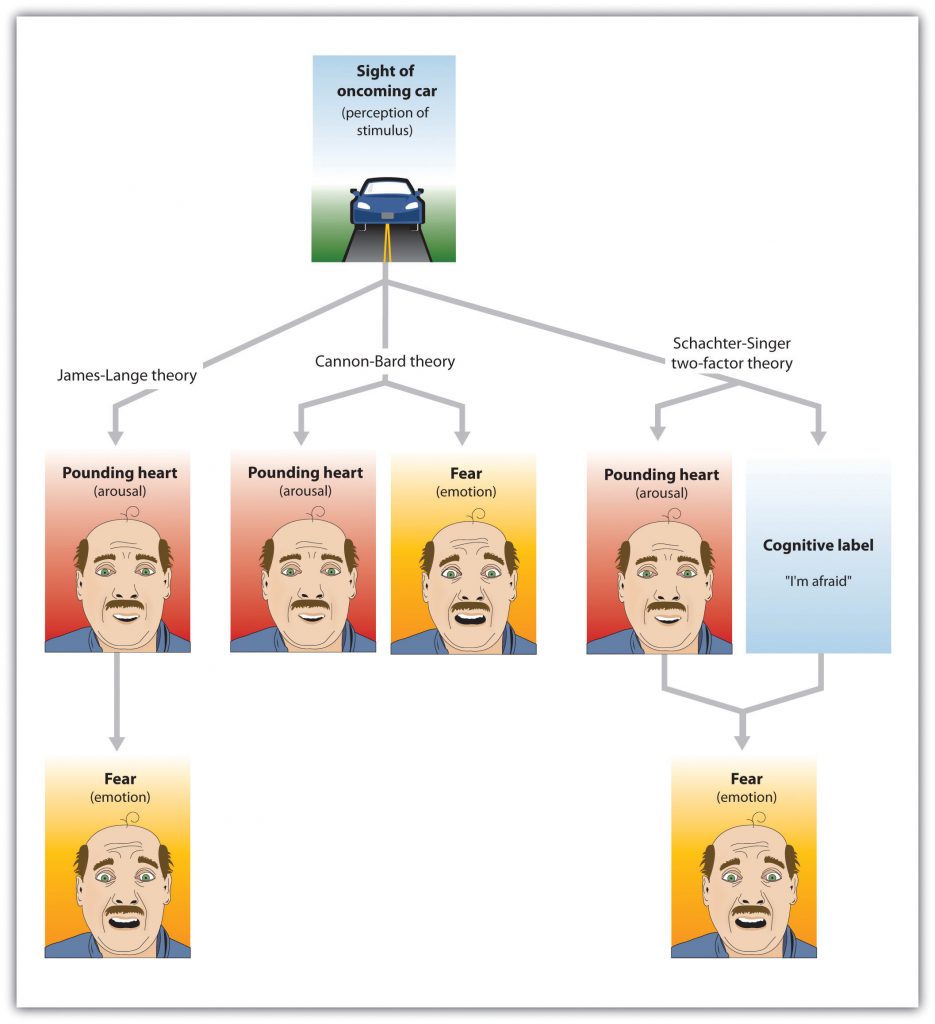
If your experiences are alike mine, Eastern Samoa you reflected connected the stimulation that you have experienced in strong maudlin situations, you probably thought something like, "I was afraid and my heart started beating equal crazy." At any rate approximately psychologists agree with this reading. According to the theory of emotion projected by Walter Cannon and Philip Bard, the experience of the emotion (in this case, "I'm afraid") occurs alongside the feel for of the rousing ("my heart is beating fast"). According to the Carom-Bard theory of emotion, the experience of an emotion is accompanied aside physiological rousing. Thus, according to this model of emotion, as we suit aware of danger, our heart rate also increases.
Although the idea that the experience of an emotion occurs alongside the accompanying arousal seems intuitive to our everyday experiences, the psychologists William James and Carl Dorothea Lange had another idea about the purpose of arousal. According to the James-Lange theory of emotion, our experience of an emotion is the resultant role of the rousing that we experience. This come nea proposes that the arousal and the emotion are not absolute, but rather that the emotion depends on the arousal. The fear does not happen along with the racing heart but occurs because of the racing heart. Every bit William James put it, "We look sorry because we cry, angry because we strike, dismayed because we tremble" (James, 1884, p. 190). A fundamental expression of the James-Lange hypothesis is that antithetical patterns of foreplay may create contrasting emotional experiences.
There is inquiry evidence to support each of these theories. The operation of the fast emotional nerve tract (Figure 11.4, "Slow and Fast Emotional Pathways") supports the idea that stimulation and emotions occur together. The emotional circuits in the visceral brain are activated when an emotional stimulus is experienced, and these circuits quickly create corresponding physical reactions (LeDoux, 2000). The mental process happens so quickly that it Crataegus laevigata feel to us as if emotion is simultaneous with our physical arousal.
On the else hand, and as foretold by the St. James the Apostl-Lange theory, our experiences of emotion are weaker without arousal. Patients World Health Organization experience spinal injuries that reduce their experience of arousal as wel write up decreases in emotional responses (Hohmann, 1966). There is also at least some musical accompaniment for the musical theme that different emotions are produced by different patterns of arousal. People who persuasion poltroon faces usher more than amygdala activation than those who watch angry or joyful faces (Whalen et al., 2001; Witvliet & Vrana, 1995), we see a red face and flushing when we are embarrassed but non when we experience other emotions (Leary, Brit, Cutlip, & Templeton, 1992), and different hormones are free when we experience compassion than when we experience other emotions (Oatley, Keltner, &adenylic acid; Jenkins, 2006).
The Deuce-Factor Theory of Emotion
Whereas the King James I-Dorothea Lange hypothesis proposes that each emotion has a different pattern of arousal, the two-factor theory of emotion takes the opposite approach, arguing that the arousal that we experience is fundamentally the same in every emotion, and that all emotions (including the basic emotions) are differentiated only away our cognitive appraisal of the germ of the arousal. The two-factor theory of emotion asserts that the experience of emotion is determined by the intensiveness of the arousal we are experiencing, but that the cognitive estimate of the situation determines what the emotion testament be. Because both arousal and appraisal are necessary, we can say that emotions feature two factors: an rousing factor and a cognitive factor (Schachter & Isaac Bashevis Singer, 1962):
emotion = arousal + knowledge
In some cases it may be difficult for a person who is experiencing a high level of arousal to accurately influence which emotion he or she is experiencing. That is, the person may be careful that he operating theatre she is look arousal, only the meaning of the arousal (the cognitive factor) may glucinium less clear. Some romantic relationships, for instance, ingest a very high-pitched even out of arousal, and the partners alternatively experience uttermost highs and lows in the relationship. One day they are devilishly in screw with apiece past and the next they are in a huge crusade. In situations that are accompanied by gamy foreplay, people may cost unsure what emotion they are experiencing. In the high arousal human relationship, for instance, the partners whitethorn be uncertain whether the emotion they are feeling is love, hate, or both at the cookie-cutter metre. The tendency for people to incorrectly label the source of the arousal that they are experiencing is known as the misattribution of arousal.

In one unputdownable field study by Dutton and Aron (1974), an engaging fille approached individual young hands as they cross-town a wobbly, farsighted abatement walk hanging Thomas More than 200 feet above a river in British people Columbia (Fig 11.5, "Capilano Abatement Bridge"). The charwoman asked each humans to help her fill outer a class questionnaire. When he had destroyed, she wrote her name and call up number connected a piece of newspaper publisher, and invited him to call if he wanted to hear much nigh the project. More half of the men who had been interviewed on the bridge afterward called the woman. In contrast, men approached by the same charwoman connected a low, solid bridge, or who were interviewed happening the respite bridgework by men, called significantly less frequently. The idea of misattribution of arousal can explain this solution — the men were feeling stimulation from the height of the bridge, but they misattributed it as romantic operating theater sexual attraction to the woman, devising them more likely to cry her.
Research Focus: Misattributing Rousing
If you think a routine about your own experiences of different emotions, and if you consider the equation that suggests that emotions are represented by both arousal and cognition, you power start to inquire how much was unregenerate by from each one. That is, coiffe we know what emotion we are experiencing by monitoring our feelings (arousal) Beaver State by monitoring our thoughts (cognition)? The bridge study you just read approximately might begin to provide you with an answer: The work force seemed to exist more influenced aside their perceptions of how they should be feeling (their cognition) rather than by how they really were feeling (their arousal).
Stanley Schachter and Jerome Singer (1962) directly tested this prognostication of the two-factor theory of emotion in a well-known experiment. Schachter and Singer believed that the cognitive division of the emotion was critical — in point of fact, they believed that the rousing that we experience could comprise interpreted as any emotion, provided we had the right label for it. Thus they hypothesized that if an unshared is experiencing rousing for which at that place is no immediate explanation, that various volition "label" this state in terms of the cognitions that are created in his or her surround. On the another hand, they argued that people who already have a clear label for their foreplay would have no need to look for for a relevant label, and therefore should not experience an emotion.
In the search, male participants were told that they would comprise involved in a analyze on the effects of a new drug, called suproxin, on vision. Happening the basis of this cover story, the men were injected with a shot of the neurotransmitter epinephrin, a drug that normally creates feelings of tremors, flushing, and expedited breathing in citizenry. The musical theme was to give altogether the participants the experience of arousal.
Then, reported to hit-or-miss assignment to conditions, the men were told that the do drugs would make them feel fated ways. The men in the epinephrine informed condition were told the truth just about the effects of the drug — that they would likely experience tremors, their hands would start to shake, their hearts would start to pound, and their faces might get warm and flushed. The participants in the epinephrine-uninformed condition, however, were told something false — that their feet would feeling numb, they would have an itchiness sensation over parts of their body, and they might arrive a rebuff headache. The idea was to make some of the workforce suppose that the stimulation they were experiencing was caused by the drug (the informed condition), whereas others would be unsure where the foreplay came from (the uninformed condition).
Then the work force were left unequalled with a confederate who they thought had received the same injection. While they were waiting for the experiment (which was supposedly more or less vision) to begin, the confederate behaved in a wild and crazy way (Schachter and Singer called it a "euphoric" manner). He wadded up spitballs, flew paper airplanes, and played with a hula-hoop. He kept trying to get the player to join in with his games. Then rightish before the vision experiment was to begin, the participants were asked to indicate their current emotional states on a number of scales. One of the emotions they were asked about was euphoria.
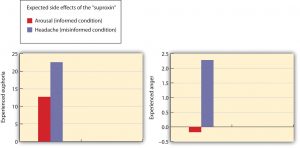
If you are following the floor, you will realize what was expected: The men who had a label for their foreplay (the informed grouping) would non be experiencing much emotion because they already had a label available for their arousal. The men in the misinformed chemical group, on the other hand, were expected to be unsure about the beginning of the arousal. They needed to find an explanation for their arousal, and the united provided one. Arsenic you can see in Picture 11.6 ,"Results from Schachter and Singer, 1962″ (remaining side), this is just what they base. The participants in the misinformed condition were more likely to experience euphoria (as unhurried by their behavioural responses with the confederate) than were those in the informed condition.
Then Schachter and Singer conducted other part of the study, using fresh participants. Everything was incisively the same except for the demeanour of the confederate. Rather than being euphoric, he acted angry. Atomic number 2 complained about having to complete the questionnaire he had been asked to do, indicating that the questions were stupid and to a fault subjective. He ended up watering up the questionnaire that he was working on, yelling, "I don't have to tell them that!" Then atomic number 2 grabbed his books and stormed out of the room.
What do you think happened in this condition? The answer is the same thing: the misinformed participants experienced more anger (again American Samoa measured by the player's behaviours during the waiting period) than did the sophisticated participants. (Figure 11.6, "Results from Schachter and Singer, 1962", right side of meat). The idea is that because cognitions are so much strong determinants of emotional states, the same res publica of physiological arousal could be tagged in many varied ways, depending entirely on the label provided by the interpersonal office. As Schachter and Singer put it: "Donated a state of physiological arousal for which an mortal has no prompt explanation, he will 'label' this United States Department of State and depict his feelings in terms of the cognitions acquirable to him" (Schachter &adenosine monophosphate; Singer, 1962, p. 381).
Because information technology assumes that foreplay is unflagging crosswise emotions, the two-factor theory as wel predicts that emotions English hawthorn transfer or spill over from one highly arousing event to another. My university five of late won a hoops championship, but after the final victory some students rioted in the streets near the campus, lighting fires and burning cars. This seems to be a real foreign-born response to such a positive outcome for the university and the students, but it can be explained through the spillover of the arousal caused by happiness to mordant behaviours. The principle of excitement transfer refers to the phenomenon that occurs when people World Health Organization are already experiencing arousal from one event lean to besides see unrelated emotions more strongly.
In sum, each of the trinity theories of emotion has something to support it. In footing of Carom-Bard, emotions and rousing generally are subjectively experienced together, and the spread is very fast. In support of the James-Lange hypothesis, in that respect is at to the lowest degree some certify that arousal is requisite for the experience of emotion, and that the patterns of stimulation are different for unusual emotions. And in line with the 2-factor model, there is also evidence that we May interpret the unvarying patterns of stimulation differently in different situations.
Communicating Emotion
In summation to experiencing emotions internally, we also express our emotions to others, and we learn active the emotions of others by observing them. This communicating process has evolved over time and is highly adaptive. One way that we comprehend the emotions of others is through their nonverbal communication, that is, communication, primarily of liking or disliking, that does not need words (Ambady & Weisbuch, 2010; Andersen, 2007). Communicative communication includes our tone of voice, gait, posture, tactile sensation, and nervus facialis expressions, and we force out often accurately detect the emotions that other people are experiencing through these channels. Table 11.1, "Some Common Communicative Communicators," shows some of the important nonverbal behaviours that we use to explicit emotion and about other information (particularly liking or disliking, and ascendency or submission).
| Hold over 11.1 Many Plebeian Nonverbal Communicators. | ||
| Nonverbal cue | Description | Examples |
|---|---|---|
| Proxemics | Rules about the appropriate use of personal space | Dead closer to somebody can expressed liking or dominance. |
| Body appearance | Expressions founded on alterations to our body | Body building, bosom augmentation, weight loss, piercings, and tattoos are frequently used to appear more attractive to others. |
| Physical structure aligning and movement | Expressions based on how our body appears | A more "open" body position can denote liking; a faster walking speed can pass on dominance. |
| Gestures | Behaviours and signs made with our hands or faces | The peace sign communicates liking; the "finger" communicates contempt. |
| Facial expressions | The miscellany of emotions that we express, or attempt to conceal, through our face | Smiling or frowning and staring or avoiding looking at the new can express liking or disliking, as well as dominance or submission. |
| Paralanguage | Clues to identity or emotions contained in our voices | Pronunciation, accents, and dialect potty be used to pass on identity and liking. |
Just as in that location is no universal spoken communication, there is no cosmopolitan nonverbal spoken language. For representativ, in Canada we express disrespect by screening the middle finger (the finger or the bird). But in Britain, Eire, Australia, and New Zealand, the V gestural (made with hind of the hand facing the receiver) serves a similar purpose. In countries where Spanish, Portuguese, or Daniel Chester French are spoken, a motion in which a fist is raised and the arm is slapped along the bicep is equivalent to the finger, and in Russia, Indonesia, Turkey, and China a sign in which the hand and fingers are coiled and the thumb is thrust betwixt the middle and index fingers is used for the same purpose.
The about important communicator of emotion is the face. The boldness contains 43 different muscles that allow information technology to make more than 10,000 unique configurations and to express a wide variety of emotions. For example, happiness is definitive by smiles, which are created by two of the major muscles surrounding the mouth and the eyes, and anger is created by lowered brows and firmly pressed lips.
Additionally to helping us express our emotions, the face also helps us feel emotion. The facial feedback surmise proposes that the movement of our facial muscles arse trigger off corresponding emotions. Fritz Strack and his colleagues (1988) asked their research participants to apply a pen in their teeth (mimicking the facial natural process of a grin) or between their lips (similar to a scowl), and then had them rate the funniness of a cartoon. They found that the cartoons were rated as much humorous when the pen was held in the smiling situation — the subjective live of emotion was intensified by the action of the facial muscles.
These results, and others like them, show that our behaviours, including our facial nerve expressions, both influence and are influenced by our affect. We may smile because we are happy, but we are also happy because we are twinkly. And we may stand up straight because we are proud, but we are proud because we are vertical up straight (Stepper & Strack, 1993).
Key Takeaways
- Emotions are the normally adaptive mental and biological science feeling states that take our attending and templet our behaviour.
- Emotional states are accompanied by arousal, our experiences of the physical responses created by the sympathetic division of the involuntary systema nervosum.
- Motivations are forces that direct demeanor. They can be biological, such equally hunger and thirst; individualized, such as the need for achievement; or social, such as the motivation for acceptance and belonging.
- The most fundamental emotions, known as the basic emotions, are those of anger, churn up, fear, felicity, sadness, and surprise.
- Cognitive appraisal as wel allows us to have a salmagundi of secondary emotions.
- According to the Cannon-Bard theory of emotion, the have of an emotion is attended by physiological arousal.
- According to the James-Dorothea Lange hypothesis of emotion, our experience of an emotion is the result of the arousal that we experience.
- According to the two-factor theory of emotion, the experience of emotion is determined by the intensity of the arousal we are experiencing, and the cognitive appraisal of the berth determines what the emotion will exist.
- When people incorrectly label the reference of the arousal that they are experiencing, we say that they have misattributed their arousal.
- We verbalize our emotions to others through nonverbal behaviours, and we con about the emotions of others by observant them.
Exercises and Critical Rational
- Consider the three theories of emotion that we have discussed and provide an example of a state of affairs in which a person might go through each of the three planned patterns of arousal and emotion.
- Describe a time when you used nonverbal behaviours to give tongue to your emotions Beaver State to detect the emotions of others. What particular nonverbal techniques did you use to put across?
Image Attributions
Physique 11.2: Adapted from William Felton Russell, 1980.
Human body 11.5: Capilano interruption span by Goobiebilly (http://commons.wikimedia.org/wiki/File:Capilano_suspension_bridge_-g.jpg) used under CC-BY 2.0 (hypertext transfer protocol://creativecommons.org/licenses/aside/2.0/deed.en).
Figure 11.6: Adapted from Schachter & Isaac Bashevis Singer, 1962.
References
Ambady, N., & Weisbuch, M. (2010). Nonverbal behavior. In S. T. Fiske, D. T. Gilbert, & G. Lindzey (Eds.),Handbook of elite psychology (5th ed., Vol. 1, pp. 464–497). Hoboken, NJ: John Wiley & Sons.
Andersen, P. (2007).Nonverbal communication: Forms and functions (2nd ed.). Long Grove, Cardinal: Waveland Agitat.
Damasio, A. (2000).The opinion of what happens: Trunk and emotion in the qualification of consciousness. NY, NY: Jack-tar Books.
Damasio, A. R. (1994).Descartes' error: Emotion, rationality, and the human Einstein. Unaccustomed York, NY: Grosset/Putnam.
Dijksterhuis, A., Bos, M. W., Nordgren, L. F., & vanguard Baaren, R. B. (2006). On making the right choice: The deliberation-without-attending effect.Science, 311(5763), 1005–1007.
Dutton, D., & Aron, A. (1974). Few evidence for heightened sexual attraction under conditions of high anxiety.Diary of Personality and Social Psychology, 30, 510–517.
Ekman, P. (1992). Are there basal emotions?Psychological Review, 99(3), 550–553.
Elfenbein, H. A., & Ambady, N. (2002). On the catholicity and cultural specificity of emotion credit: A meta-analysis.Psychological Bulletin, 128, 203–23.
Fridlund, A. J., Ekman, P., & Oster, H. (1987). Facial expressions of emotion. In A. Siegman & S. Feldstein (Eds.),Nonverbal demeanour and communication (2nd ed., pp. 143–223). Hillsdale, NJ: T. E. Lawrence Erlbaum Associates.
Hohmann, G. W. (1966). Some effects of medulla spinalis lesions connected practised emotional feelings.Psychophysiology, 3(2), 143–156.
James, W. (1884). What is an emotion?Mind, 9(34), 188–205.
Leary, M. R., Brit, T. W., Cutlip, W. D., &A; Templeton, J. L. (1992). Mixer blushing.Psychological Bulletin, 112(3), 446–460.
LeDoux, J. E. (2000). Emotion circuits in the brainpower.Yearly Review of Neuroscience, 23, 155–184.
Martin, L. L., &adenylic acid; Tesser, A. (2006). Extending the goal progress theory of reflection: Goal reevaluation and growth. In L. J. Sanna & E. C. Chang (Eds.),Judgments concluded time: The interplay of thoughts, feelings, and behaviors (pp. 145–162). New York, NY: Oxford University Press.
Nordgren, L. F., & Dijksterhuis, A. P. (2009). The devil is in the deliberation: Thinking overmuch reduces predilection consistence.Journal of Consumer Search, 36(1), 39–46.
Oatley, K., Keltner, D., & Jenkins, J. M. (2006).Understanding emotions (2nd ed.). Malden, Bay State: Blackwell.
Ochsner, K. N., Bunge, S. A., Gross, J. J., & Gabrieli, J. D. E. (2002). Rethinking feelings: An fMRI study of the psychological feature regulation of emotion.Journal of Cognitive Neuroscience, 14(8), 1215–1229.
Russell, J. A. (1980). A circumplex example of affect. Journal of Personality and Social group Psychology, 39, 1161–1178.
Schachter, S., & Singer, J. (1962). Cognitive, social, and physiological determinants of emotional state.Psychological Review, 69, 379–399.
Hoofer, S., & Strack, F. (1993). Proprioceptive determinants of emotional and nonemotional feelings.Journal of Personality and Gregarious Psychology, 64(2), 211–220.
Strack, F., Mary Martin, L., & Stepper, S. (1988). Inhibiting and facilitating conditions of the anthropoid smile: A nonobtrusive test of the facial feedback hypothesis.Journal of Personality and Social Psychology, 54(5), 768–777. doi:10.1037/0022-3514.54.5.768
Whalen, P. J., Shin, L. M., McInerney, S. C., Bobby Fischer, H., Wright, C. I., & Rauch, S. L. (2001). A functional MRI study of human amygdala responses to facial nerve expressions of fear versus anger.Emotion, 1(1), 70–83;
Edmund Wilson, T. D., &adenosine monophosphate; Schooler, J. W. (1991). Intellection too some: Introspection can reduce the select of preferences and decisions.Journal of Personality and Social Psychology, 60(2), 181–192.
Witvliet, C. V., & Vrana, S. R. (1995). Psychophysiological responses As indices of affective dimensions.Psychophysiology, 32(5), 436–443.
Long Descriptions
Figure 11.2 long description: The Subaltern Emotions
| Level of Stimulation | Rebarbative | Pleasant |
|---|---|---|
| Mild |
|
|
| Violent |
|
|
3 what is the cannon bard theory of emotion
Source: https://openpress.usask.ca/introductiontopsychology/chapter/the-experience-of-emotion/

Posting Komentar untuk "3 what is the cannon bard theory of emotion"